

A button is like a little clip that holds your clothes together. Usually, it's round and made of different stuff. You push it through a hole to keep your outfit on.
Buttons aren't just useful; they can also make your clothes look cool.
**Different Kinds of Buttons**
Here's a quick rundown of the main types you'll find:
**How They're Made**
* **Flat (2 or 4 holes):** These are super common on shirts and stuff. You just sew them on through the holes.
* **Shank:** These have a loop on the back instead of holes. They're often on coats, so the fabric hangs better.
* **Snap:** These are like two puzzle pieces that click together. You see them on jeans and kids' clothes.
* **Toggle:** These are long and skinny, often made of wood. They use a loop to stay put, like on those duffle coats.
* **Magnetic:** They use magnets to stick. You find them in bags or clothes made for people who need easy-to-use stuff.
* **Just for Looks:** Some buttons are just for show and don't actually do anything.
**What They're Made Of**
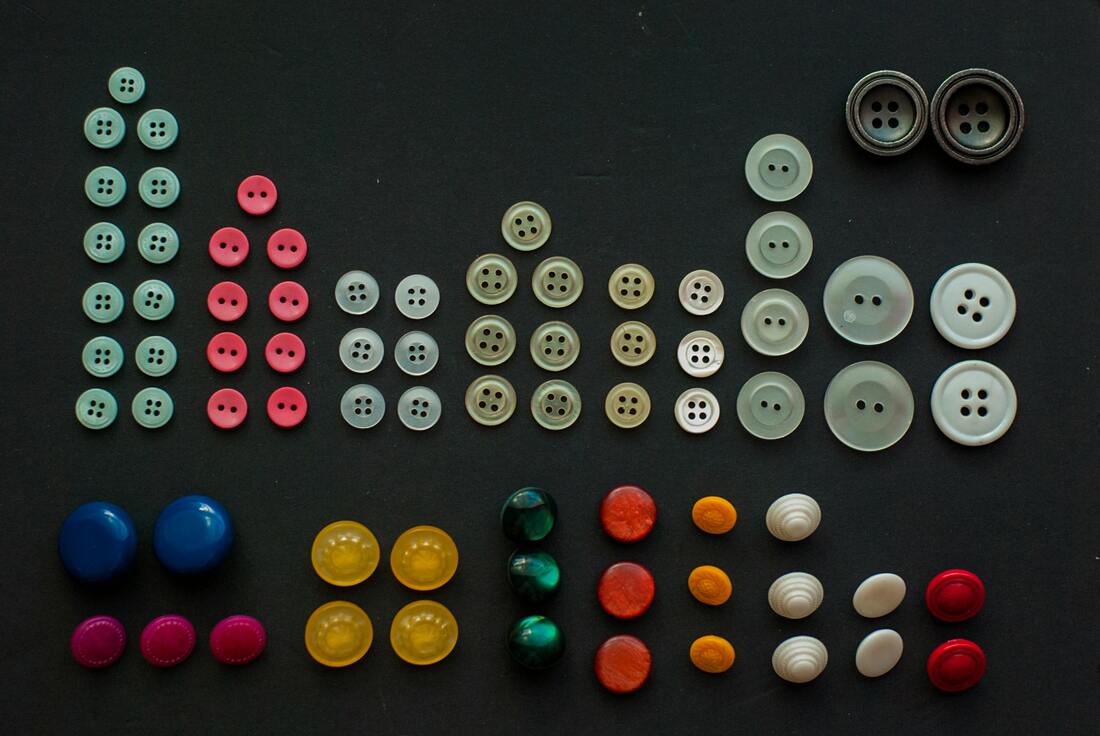
Buttons can be made of almost anything. Here are some examples:
* **Natural:** Shell, wood - Nice-looking, good for the environment, and each one is a little different.
* **Metal:** Steel, zinc - Tough, good for jeans and coats.
* **Plastic:** Cheap, lots of colors.
* **Fabric-covered:** Matches your clothes.
* **Glass/Ceramic:** Fancy and breakable.
* **Rubber:** Soft, good for kids' clothes.
**Button Sizes**
Buttons are measured in lignes. Here are some common sizes:
* Shirt buttons: 14–18L
* Jacket buttons: 24–32L
* Coat buttons: 36–44L
* Jeans buttons: 20–24L (metal snaps)
**How to Put Them On**
* **Sewn:** The usual way, with thread.
* **Riveted:** Used on jeans.
* **Snapped:** Pressed together.
* **Glued:** Sometimes done if it's cheap or for something special.
**Where They Go on Clothes**
* Shirts: On the front, cuffs, and collar.
* Pants: On the waistband.
* Jackets: On the front and sleeves.
* Skirts: On the side.
* Bags: Just for show.
**Which Side They Go On**
* Men's clothes: Buttons on the right.
* Women's clothes: Buttons on the left.
This is because way back, rich women had people to dress them.
**How They Look**
* Shiny, dull, old-looking, colored.
* With designs or words on them.
* Round, square, heart-shaped.
**Taking Care of Them**
* Don't wash delicate buttons too hard.
* Check the thread to ensure they're not loose.
* Cover or take off fancy buttons before dry cleaning.
* Keep plastic buttons away from heat.
**Tools and Tips for Sewing**
* You'll need: A needle, thread, scissors, and maybe a sewing machine.
* Sew them on tight with strong thread.
* Leave a little space under the button if the fabric is thick.
* Use a small button on the back for heavy clothes.
**Cool Stuff Now**
* Buttons made from plants or recycled stuff.
* You can get buttons with custom designs.
* Smart buttons with chips in them.
Buttons aren't just useful; they can also make your clothes look cool.
**Different Kinds of Buttons**
Here's a quick rundown of the main types you'll find:
**How They're Made**
* **Flat (2 or 4 holes):** These are super common on shirts and stuff. You just sew them on through the holes.
* **Shank:** These have a loop on the back instead of holes. They're often on coats, so the fabric hangs better.
* **Snap:** These are like two puzzle pieces that click together. You see them on jeans and kids' clothes.
* **Toggle:** These are long and skinny, often made of wood. They use a loop to stay put, like on those duffle coats.
* **Magnetic:** They use magnets to stick. You find them in bags or clothes made for people who need easy-to-use stuff.
* **Just for Looks:** Some buttons are just for show and don't actually do anything.
**What They're Made Of**
Buttons can be made of almost anything. Here are some examples:
* **Natural:** Shell, wood - Nice-looking, good for the environment, and each one is a little different.
* **Metal:** Steel, zinc - Tough, good for jeans and coats.
* **Plastic:** Cheap, lots of colors.
* **Fabric-covered:** Matches your clothes.
* **Glass/Ceramic:** Fancy and breakable.
* **Rubber:** Soft, good for kids' clothes.
**Button Sizes**
Buttons are measured in lignes. Here are some common sizes:
* Shirt buttons: 14–18L
* Jacket buttons: 24–32L
* Coat buttons: 36–44L
* Jeans buttons: 20–24L (metal snaps)
**How to Put Them On**
* **Sewn:** The usual way, with thread.
* **Riveted:** Used on jeans.
* **Snapped:** Pressed together.
* **Glued:** Sometimes done if it's cheap or for something special.
**Where They Go on Clothes**
* Shirts: On the front, cuffs, and collar.
* Pants: On the waistband.
* Jackets: On the front and sleeves.
* Skirts: On the side.
* Bags: Just for show.
**Which Side They Go On**
* Men's clothes: Buttons on the right.
* Women's clothes: Buttons on the left.
This is because way back, rich women had people to dress them.
**How They Look**
* Shiny, dull, old-looking, colored.
* With designs or words on them.
* Round, square, heart-shaped.
**Taking Care of Them**
* Don't wash delicate buttons too hard.
* Check the thread to ensure they're not loose.
* Cover or take off fancy buttons before dry cleaning.
* Keep plastic buttons away from heat.
**Tools and Tips for Sewing**
* You'll need: A needle, thread, scissors, and maybe a sewing machine.
* Sew them on tight with strong thread.
* Leave a little space under the button if the fabric is thick.
* Use a small button on the back for heavy clothes.
**Cool Stuff Now**
* Buttons made from plants or recycled stuff.
* You can get buttons with custom designs.
* Smart buttons with chips in them.
**A. How Buttons Are Designed**
* First, you figure out the shape and size. This can be done with a computer (CAD) or just by drawing it out.
* Next, you pick what it's going to be made of – plastic, metal, something natural?
* Then you decide how the surface will look – smooth, shiny, colored, or with a design carved into it.
**B. How Buttons Are Made**
* **Plastic Buttons:**
* They're made using a mold.
* After that, they cool off, and any extra bits are trimmed away.
* Then they're polished and colored.
* Lastly, holes are drilled, or those loop things (shanks) are added to the back.
* **Metal Buttons:**
* The metal disc is stamped out or cast.
* A design is carved or pressed into it.
* It gets a coating – could be nickel, brass, or something that looks old.
* Then, backs or shanks are attached.
* **Buttons From Natural Stuff:**
* The material is cut into the right shape.
* It's shaped and drilled.
* Finally, it's sanded down, polished, and waxed.
**C. Making Sure They're Good**
* The color has to be consistent, the surface has to be smooth, the holes have to line up correctly, and they need to be strong.
* Buttons are tested to make sure they can handle being washed and dry-cleaned.
**⚙️ 14. Types of Buttons (and What They're For)**
| Type | Clothing Use | Notes |
| --------------- | ------------------- | -------------------------------------------------------------------------------------------------------------------------------------------------------------------------------------------- |
| Dress Buttons | Shirts, blouses | Small, pretty, not too heavy |
| Coat Buttons | Jackets, coats | Bigger and tougher |
| Jean Buttons | Denim pants | Metal and riveted on so they don't come off easily |
| Uniform Buttons | Military, formalwear| Have designs on them, metal |
| Kid's Buttons | Children’s wear | Safe for kids, bigger, and colorful |
| Sports Buttons | Activewear | Snap or magnetic, won't break if you fall |
| Cuff Buttons | Shirt cuffs | Usually smaller, can match the shirt or be a different color |
| Vest Buttons | Suits, vests | Small, fancy, often have a loop on the back |
**🧩 15. Cool and Unusual Buttons**
* **Jeweled Buttons:** Have little stones or crystals stuck in them.
* **Fabric-covered Buttons:** Covered in the same material as the clothes they're on.
* **Embossed Buttons:** Have designs that stick out.
* **Laser-cut Buttons:** Have really precise, modern designs.
* **Novelty Buttons:** Shaped like stars, animals, etc.—used on kids' clothes or for crafts.
* **Handmade Buttons:** Made by artists, so they're one-of-a-kind, often made of pottery or wood.
**🧷 16. Buttonholes (Where the Button Goes)**
| Buttonhole Type | Common Use | Description |
| --------------- | -------------------- | -------------------------------------------------------------- |
| Machine-stitched| Shirts, blouses | Made with a regular sewing machine |
| Hand-stitched | Fancy clothes | Really tight and neat stitches |
| Bound buttonhole| Coats, jackets | The edges of the fabric are folded over and sewn down nicely |
| Loop buttonhole | Sweaters, underwear | Made from a loop of thread or cord |
| Elastic loop | Dresses | Stretchy |
**🧥 17. How Designers Use Buttons**
Fashion designers think about:
* Whether the buttons are placed evenly (looks good).
* If the colors match or stand out (creates a certain look).
* How big or small the buttons are compared to the garment.
* How they feel – a nice texture can make something feel expensive.
* What story they tell – old brass buttons feel vintage, simple black buttons feel modern.
**🔬 18. Button Facts (For Manufacturers)**
| Property | Description |
| ----------------- | ------------------------------------------------ |
| Breaking strength | Shirt buttons should be able to handle at least 90N|
| Colorfastness | Shouldn't fade after being washed 5 times at 60°C|
| Heat resistance | Polyester can handle up to 180°C |
| Chemical resistance| Should hold up to detergent, bleach, etc. |
| Size | Can only be off by about ±0.2 mm |
**🧠 19. What Buttons Mean**
* **Military buttons:** They usually show a symbol of rank.
* **Royal clothing:** Used as decoration, sometimes made of gold or silver.
* **Superstitions:** Finding a button used to be considered good luck.
* **Fashion:** Can show rebellion or elegance.
**🌿 20. New Ideas**
* **Buttons that break down:** Made from cornstarch, shell, or nuts.
* **Buttons from trash:** Made from old clothes or plastic from the ocean.
* **3D-printed buttons:** Made-to-order with no wasted material.
* **Smart buttons:** Have chips in them that let you do stuff like interact with the clothes.
**🧰 21. Button Stuff**
* **Button card:** The cardboard thing buttons come on.
* **Buttonhole twist:** Strong thread for making buttonholes.
* **Button shank:** The little stem under the button.
* **Backer button:** A hidden button to make things stronger.
* **Button stand:** How much the fabric overlaps where the button goes.
* **Button gauge:** A tool to measure button size.
**🎨 22. Button Style**
* Simple, smooth surfaces for modern clothes.
* Bringing back old-fashioned styles like horn and wood.
* See-through plastic for a clean look.
* Huge buttons that stand out.
* Buttons with custom designs on them.
* First, you figure out the shape and size. This can be done with a computer (CAD) or just by drawing it out.
* Next, you pick what it's going to be made of – plastic, metal, something natural?
* Then you decide how the surface will look – smooth, shiny, colored, or with a design carved into it.
**B. How Buttons Are Made**
* **Plastic Buttons:**
* They're made using a mold.
* After that, they cool off, and any extra bits are trimmed away.
* Then they're polished and colored.
* Lastly, holes are drilled, or those loop things (shanks) are added to the back.
* **Metal Buttons:**
* The metal disc is stamped out or cast.
* A design is carved or pressed into it.
* It gets a coating – could be nickel, brass, or something that looks old.
* Then, backs or shanks are attached.
* **Buttons From Natural Stuff:**
* The material is cut into the right shape.
* It's shaped and drilled.
* Finally, it's sanded down, polished, and waxed.
**C. Making Sure They're Good**
* The color has to be consistent, the surface has to be smooth, the holes have to line up correctly, and they need to be strong.
* Buttons are tested to make sure they can handle being washed and dry-cleaned.
**⚙️ 14. Types of Buttons (and What They're For)**
| Type | Clothing Use | Notes |
| --------------- | ------------------- | -------------------------------------------------------------------------------------------------------------------------------------------------------------------------------------------- |
| Dress Buttons | Shirts, blouses | Small, pretty, not too heavy |
| Coat Buttons | Jackets, coats | Bigger and tougher |
| Jean Buttons | Denim pants | Metal and riveted on so they don't come off easily |
| Uniform Buttons | Military, formalwear| Have designs on them, metal |
| Kid's Buttons | Children’s wear | Safe for kids, bigger, and colorful |
| Sports Buttons | Activewear | Snap or magnetic, won't break if you fall |
| Cuff Buttons | Shirt cuffs | Usually smaller, can match the shirt or be a different color |
| Vest Buttons | Suits, vests | Small, fancy, often have a loop on the back |
**🧩 15. Cool and Unusual Buttons**
* **Jeweled Buttons:** Have little stones or crystals stuck in them.
* **Fabric-covered Buttons:** Covered in the same material as the clothes they're on.
* **Embossed Buttons:** Have designs that stick out.
* **Laser-cut Buttons:** Have really precise, modern designs.
* **Novelty Buttons:** Shaped like stars, animals, etc.—used on kids' clothes or for crafts.
* **Handmade Buttons:** Made by artists, so they're one-of-a-kind, often made of pottery or wood.
**🧷 16. Buttonholes (Where the Button Goes)**
| Buttonhole Type | Common Use | Description |
| --------------- | -------------------- | -------------------------------------------------------------- |
| Machine-stitched| Shirts, blouses | Made with a regular sewing machine |
| Hand-stitched | Fancy clothes | Really tight and neat stitches |
| Bound buttonhole| Coats, jackets | The edges of the fabric are folded over and sewn down nicely |
| Loop buttonhole | Sweaters, underwear | Made from a loop of thread or cord |
| Elastic loop | Dresses | Stretchy |
**🧥 17. How Designers Use Buttons**
Fashion designers think about:
* Whether the buttons are placed evenly (looks good).
* If the colors match or stand out (creates a certain look).
* How big or small the buttons are compared to the garment.
* How they feel – a nice texture can make something feel expensive.
* What story they tell – old brass buttons feel vintage, simple black buttons feel modern.
**🔬 18. Button Facts (For Manufacturers)**
| Property | Description |
| ----------------- | ------------------------------------------------ |
| Breaking strength | Shirt buttons should be able to handle at least 90N|
| Colorfastness | Shouldn't fade after being washed 5 times at 60°C|
| Heat resistance | Polyester can handle up to 180°C |
| Chemical resistance| Should hold up to detergent, bleach, etc. |
| Size | Can only be off by about ±0.2 mm |
**🧠 19. What Buttons Mean**
* **Military buttons:** They usually show a symbol of rank.
* **Royal clothing:** Used as decoration, sometimes made of gold or silver.
* **Superstitions:** Finding a button used to be considered good luck.
* **Fashion:** Can show rebellion or elegance.
**🌿 20. New Ideas**
* **Buttons that break down:** Made from cornstarch, shell, or nuts.
* **Buttons from trash:** Made from old clothes or plastic from the ocean.
* **3D-printed buttons:** Made-to-order with no wasted material.
* **Smart buttons:** Have chips in them that let you do stuff like interact with the clothes.
**🧰 21. Button Stuff**
* **Button card:** The cardboard thing buttons come on.
* **Buttonhole twist:** Strong thread for making buttonholes.
* **Button shank:** The little stem under the button.
* **Backer button:** A hidden button to make things stronger.
* **Button stand:** How much the fabric overlaps where the button goes.
* **Button gauge:** A tool to measure button size.
**🎨 22. Button Style**
* Simple, smooth surfaces for modern clothes.
* Bringing back old-fashioned styles like horn and wood.
* See-through plastic for a clean look.
* Huge buttons that stand out.
* Buttons with custom designs on them.